
Why I Never Swear or Make Promises: The Power of an Unshakable Word

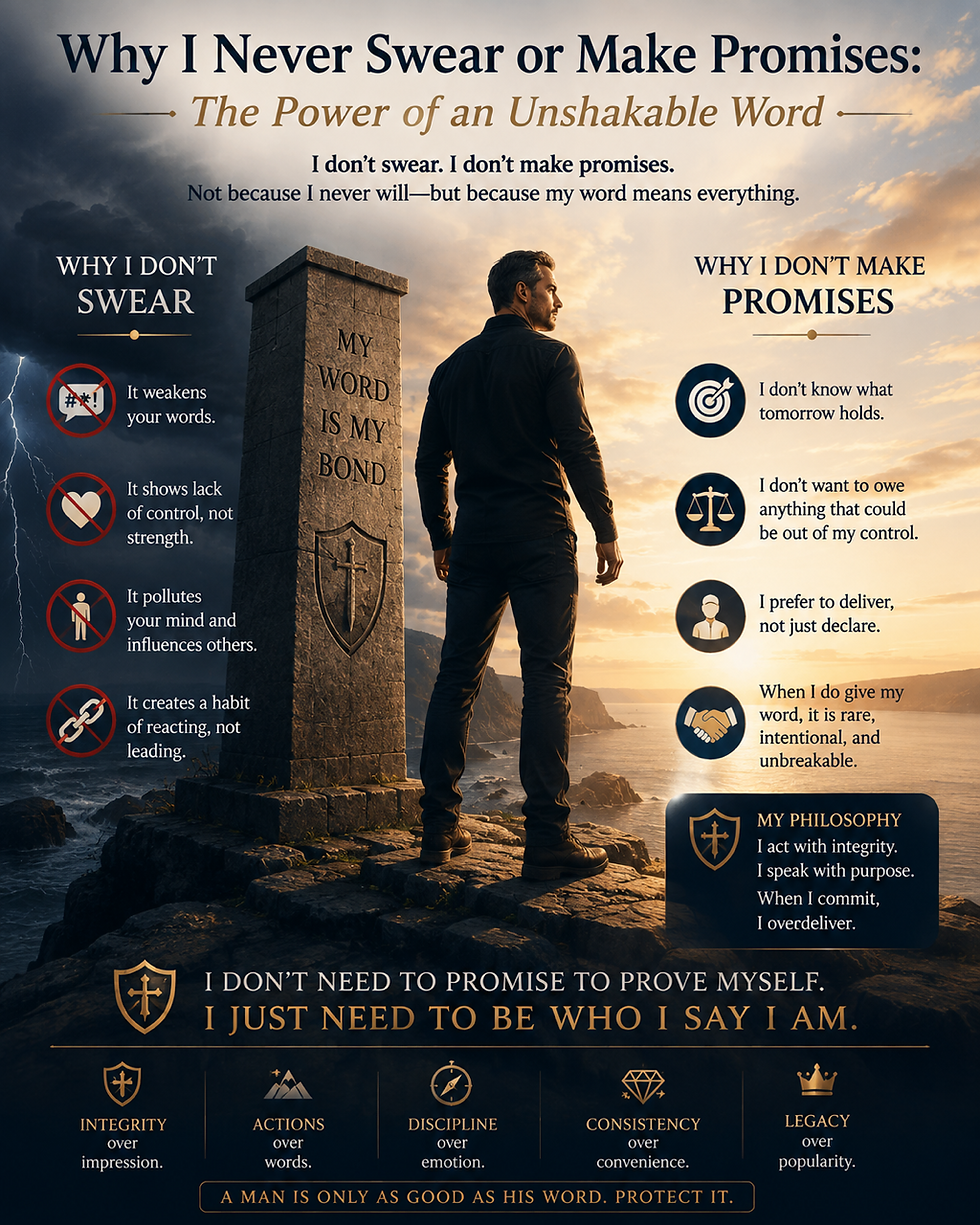
We live in a culture saturated with promises. People toss around phrases like "I promise," "I swear on my life,"or "Cross my heart" as easily as they say hello. Yet, paradoxically, we live in an era where trust is at an all-time low. The more vows people make, the less weight those vows seem to carry.
I don’t make promises. I don’t swear oaths.
To some, this might sound hesitant or non-committal at first glance. But in reality, it is the exact opposite. It is an act of deep respect for truth, accountability, and the integrity of human communication.
Here is why I take my words far too seriously to cheapen them with promises.
The Illusion of Absolute Control
When someone makes a promise, they are making a contract with the future—a time frame over which no human has total control.
People make promises all the time that they intend to keep, but they rarely consider whether they actually can. Life is unpredictable. Circumstances shift, emergencies arise, and variables outside our awareness take control.
When you make a promise without absolute certainty of the outcome, you are selling certainty where none exists.
Recognizing this isn't pessimism; it’s fundamental honesty. It is an acknowledgment of reality. When I state what I will do, I do so with an acute awareness of what is in my power—and I deliver on what I control.
Promises Often Mask Weak Integrity
Why do people feel the need to say, "I promise"?
Subconsciously, adding a promise or an oath to a statement implies a hierarchy of truth:
Standard statement: "I’ll be there tomorrow." (Might happen, might not)
Sworn statement: "I promise I’ll be there tomorrow!" (Now I really mean it)
If you must swear to be believed, what does that say about your everyday voice?
Requiring a "promise" to validate your intent admits that your plain word is insufficient. It creates a dangerous loophole where anything said without an oath becomes negotiable.
My Word Is More Than Enough
I believe in a simpler, higher standard: Your word should carry its own weight.
When I say I will do something, it isn't a casual intent—it is a conviction. It does not need a dramatic pledge, a hand on a Bible, or a theatrical declaration to make it real.
If I say yes, it means I have weighed my capabilities, assessed the reality, and committed my action.
If I am unsure, I will tell you directly that I am unsure.
If I cannot do something, I will give you a clear, unvarnished no.
This approach requires no performative promises because the integrity is built into the statement itself.
Action Over Ornamentation
At the end of the day, promises are just cheap emotional currency used to offer temporary reassurance. Results and consistent action are what actually build enduring trust.
People don't remember the grandeur of the oaths you swore; they remember whether you showed up when you said you would.
By eliminating promises and oaths from my vocabulary, I elevate the value of every single word I speak. My word doesn't need reinforcement—it stands on its own.
Leonardo Mora
CEO of Vision
GAWK Corporation



Comments