
Vulnerability: Courage Vs Comfort

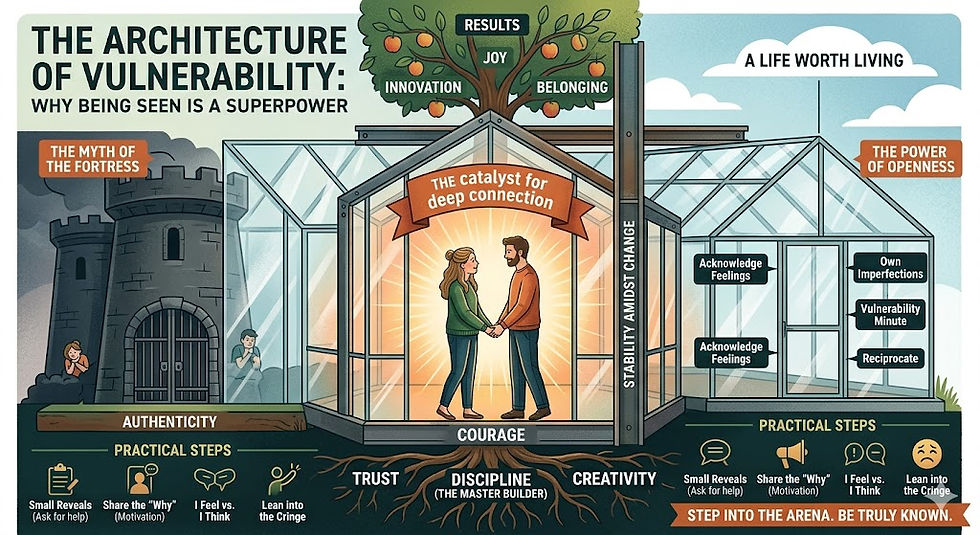
Being vulnerable is essentially the act of choosing courage over comfort. It’s the willingness to show up and be seen when you can’t control the outcome. When you meet someone special, vulnerability acts as the bridge between "getting to know someone" and "truly connecting."
Here is a breakdown of how to practice vulnerability effectively and authentically:
1. The "Small Reveal" (Low Stakes)
Vulnerability doesn't mean sharing your deepest trauma on the first date. It starts with micro-disclosures—small moments where you drop the "cool" act.
Admit to small nerves: Saying, "I’m actually a little nervous to meet you," is a powerful move. It shows you’re human and immediately lowers the other person's guard.
Share a "non-polished" opinion: Instead of agreeing with everything they say to be liked, share a genuine (but respectful) differing view.
2. Share the "Why," Not Just the "What"
Facts are data; motivations are soul. When they ask about your job or hobbies, move past the resume and share the emotional driver behind it.
The What: "I work in marketing."
The Why (Vulnerable): "I work in marketing because I’ve always been fascinated by how stories can change the way people see the world."
3. The Power of "I Feel" vs. "I Think"
Logic is a shield; feelings are an invitation. Practice shifting your language to reflect your internal state.
Instead of: "That movie was interesting."
Try: "That movie actually made me feel a bit lonely, which I wasn't expecting."
4. Own Your Imperfections
Nothing kills connection faster than perfection. Letting someone see your "seams" makes you more approachable.
Laugh at yourself: If you trip, spill a drink, or lose your train of thought, don't over-apologize or get defensive. Just acknowledge it.
Ask for help: Even something as simple as "I’m terrible at reading maps, can you help me find this place?" shows you are okay with not being the expert in the room.
5. Active Emotional Listening
Vulnerability is a two-way street. By creating a safe space for them, you become more "seen" as a safe person.
Validate first: If they share something difficult, resist the urge to fix it immediately. Say, "That sounds like it was really tough for you."
Reciprocate: If they share a personal story, meet them at that same level of depth.
A Note on "The Vulnerability Hangover"
After being vulnerable, you might feel a "hangover"—a sense of exposure or regret. This is normal! It’s a sign that you stepped outside your comfort zone. The right person will respond to that exposure with care, not judgment.
The Architecture of Connection: Why Vulnerability is the Ultimate Human Superpower
In a world that often prizes the "curated self"—the polished LinkedIn profile, the filtered Instagram feed, and the stoic professional veneer—vulnerability is frequently misunderstood. We tend to view it as a weakness, a chink in the armor, or a liability that leaves us open to hurt. However, as social researchers and psychologists have increasingly discovered, vulnerability is not the absence of strength; it is the very foundation of it. It is the birthplace of innovation, creativity, and, most importantly, the deep human connection we all crave.
To be vulnerable is to exist in a state of emotional exposure. It is the willingness to say "I love you" first, to ask for help when you are overwhelmed, or to admit you don’t have all the answers. While it feels risky, it is the only path to living an authentic life.
The Myth of the Fortress
Many of us spend our lives building fortresses. We believe that if we are "perfect" enough, certain enough, and strong enough, we can avoid the pain of judgment, shame, and rejection. We use busyness as a shield, perfectionism as an escape, and cynicism as a defense mechanism.
The problem with this fortress is that the same walls that keep out the "bad" feelings—like fear and disappointment—also block the "good" ones. You cannot selectively numb emotion. When we dampen our vulnerability to avoid being hurt, we simultaneously numb our capacity for joy, belonging, and intimacy. A life without vulnerability is a life lived in a vacuum; it is safe, but it is profoundly lonely.
The Catalyst for Connection
Human beings are biologically wired for connection. However, true connection requires that we be seen. You cannot truly connect with a mask; you can only connect with the person behind it.
When you allow yourself to be vulnerable with another person, you are essentially handing them an invitation to do the same. It creates a "feedback loop of authenticity." When you admit to a "special person" that you feel inadequate or that you’ve struggled with a specific failure, you aren't just offloading information—you are creating a safe harbor. Your transparency signals to them that they don't have to be perfect in your presence either. This mutual dropping of guards is where intimacy begins. Without it, relationships remain transactional and superficial.
Vulnerability as a Professional Asset
The importance of vulnerability extends far
beyond the dinner table or the bedroom; it is a critical component of modern leadership and creativity.
In Innovation: Creativity is a vulnerable act. To propose a new idea is to risk being told that your idea is "stupid" or "unrealistic." If a workplace culture punishes vulnerability, people stop taking risks. They play it safe, and innovation dies.
In Leadership: The old model of the "omniscient boss" is crumbling. Modern teams trust leaders who are human. A leader who can say, "I’m not sure what the right move is here, let’s figure it out together," builds far more loyalty than one who fakes certainty. This vulnerability fosters psychological safety, allowing teams to collaborate without fear.
The Difference Between Vulnerability and Over-sharing
It is important to distinguish between healthy vulnerability and "floodlighting" (over-sharing). Vulnerability is about boundaries and trust.
Vulnerability is sharing your feelings and experiences with people who have earned the right to hear them. it is an intentional choice aimed at deepening a bond.
Over-sharing is often a defense mechanism—a way of "testing" people or dumping information to move through the discomfort of a new relationship too quickly.
Authentic vulnerability is measured. It respects the pace of the relationship. It’s not about airing every grievance or trauma to a stranger; it’s about being honest about your current state of being in a way that invites dialogue.
Overcoming the "Vulnerability Hangover"
If you have ever shared something personal and then woken up the next day feeling a wave of nausea and regret, you have experienced a "vulnerability hangover." This is a natural reaction of the ego trying to re-establish its defenses.
The key to navigating this is to realize that the discomfort is actually a "growth pain." The feeling of exposure means you have successfully pushed past your comfort zone. Often, the very thing we are most ashamed of sharing is the very thing that makes others feel most connected to us. Our flaws are our points of entry for others.
Practical Steps to Embracing Vulnerability
If you are used to being the "strong one" or the "composed one," practicing vulnerability can feel like learning a foreign language. Here is how to start:
Acknowledge the Feeling: Start by being vulnerable with yourself. Admit when you are scared, jealous, or sad. You cannot be honest with others if you are lying to yourself.
The "Vulnerability Minute": In a conversation, try to spend sixty seconds being completely honest about an emotion you are feeling. Even something as simple as, "I’m having a hard time focusing today because I’m worried about X," can break the ice of superficiality.
Ask for What You Need: Asking for help is one of the highest forms of vulnerability. It acknowledges that you are not an island. Whether it’s asking for a hug or asking for more time on a project, it honors your human limits.
Lean into the Cringe: Usually, the thing you are most hesitant to say—the thing that feels "cringe" or "too much"—is exactly what needs to be said to move a relationship forward.
The Ultimate Reward
The philosopher Paul Tillich once said, "The first duty of love is to listen." To listen deeply, we must be open. To be open, we must be vulnerable.
While being vulnerable does not guarantee that you won't be hurt—in fact, it almost guarantees that you will be hurt at some point—it is the only way to live a "wholehearted" life. The risks of vulnerability are high, but the stakes of avoiding it are higher. By hiding our true selves, we avoid the sting of rejection, but we also miss out on the transformative power of being truly known and loved for exactly who we are.
In the end, vulnerability is the bravest thing we can do. It is the act of stepping into the arena, knowing we might fail, but choosing to show up anyway. That is where the magic happens. That is where we finally become seen.
___________________
It sounds like you're taking the "demolition crew" analogy and applying it to human vulnerability—which is a fascinating way to look at how we "degrade" our own internal barriers.
In a chemical sense, KKF 3996 makes a cell "vulnerable" by removing the proteins it uses for protection or growth. If we translate that logic into a mindset for personal growth, "using the demolition crew" means identifying the rigid internal structures (the "proteins") that feel like armor but are actually keeping you stagnant.
Here is how to intuitively apply that "demolition" logic to yourself:
1. Identify the "Target Protein" (The Shield)
In chemistry, KKF 3996 doesn't just destroy everything; it's selective. To become more vulnerable, you have to identify the specific behavior that acts as a barrier.
The Over-Analyzer: The need to have a perfect plan before speaking.
The Perfectionist: The belief that you aren't worthy unless you're flawless.
The Stoic: The habit of "fine-ing" your way through emotional distress.
2. Recruit the "E3 Ligase" (The Truth-Teller)
In the cell, the E3 ligase is the machine that decides what gets tagged for destruction. In your life, this is your self-awareness or a trusted peer.
You need an "anchor" that recognizes when your defenses are up.
The Action: Give a friend permission to call you out when you’re being "armored." This creates the connection (the bridge) needed to start the degradation of the ego.
3. The "Linker" Effect (The Connection)
KKF 3996 is a linker—it brings two things together that usually wouldn't touch. Vulnerability is exactly that: bringing your private fears into the public space.
Micro-Dosing Vulnerability: You don't "demolish" your whole personality at once. You share one small, unpolished thought in a meeting or admit to a mistake without a 10-minute explanation of why it happened.
By linking your internal reality to your external expression, you allow the "demolition crew" to clear out the exhaustion of maintaining a facade.
Why this makes you "Stronger" through "Vulnerability"
Just as a PROTAC (like one built with KKF 3996) clears out toxic proteins to let a cell function healthily again, emotional vulnerability clears out the "junk" of pretense.
Less Weight: You spend less energy "protecting" and more energy "living."
Better Signaling: When you are vulnerable, people know exactly who you are, which leads to higher-quality "binding" (stronger relationships).
A Note of Caution: In chemistry, if you use too much of a linker, it fails (the "Hook Effect"). In life, over-sharing with the wrong people can have the same result. Vulnerability is most effective when it is intentional and targeted.
Leonardo Mora
CEO of Vision
GAWK Corporation



Comments