
The Ultimate Blueprint: Why Competitive Swimming Teaches Kids How to Succeed at Life

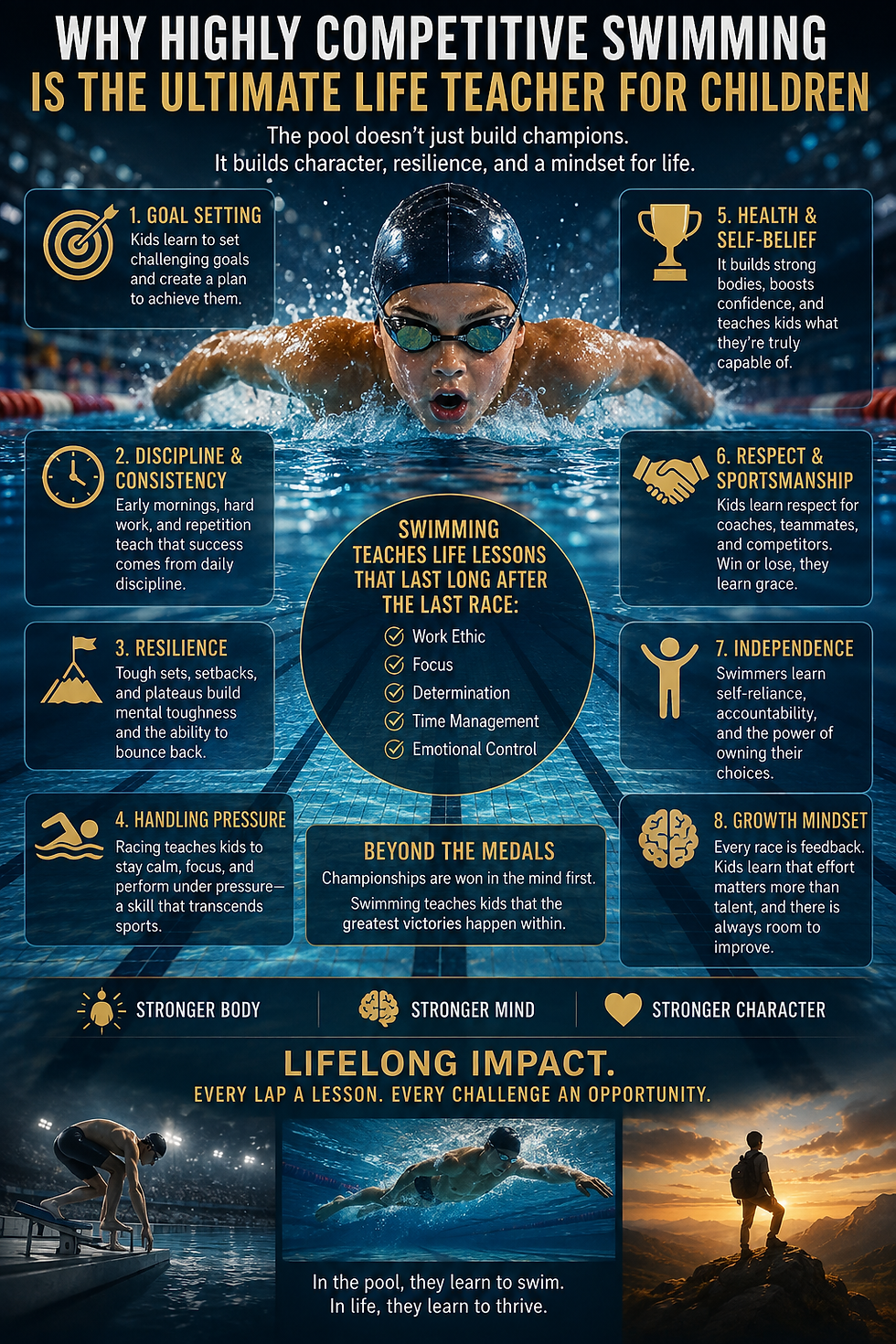
In a world filled with youth sports, parents often wonder which arena offers the greatest ROI on character, resilience, and long-term success. While soccer teaches teamwork and martial arts builds discipline, competitive swimming—especially at the collegiate and Olympic levels—stands in a class of its own.
The water is a brutal, honest, and unflinching teacher. It doesn’t allow for luck, fake effort, or excuses. If you want to raise kids who are resilient, self-driven, and built for real-world leadership, here is why putting them on a block in a 50-meter pool is the best decision you can make.
1. The Clock Doesn’t Lie: Radical Accountability
In many team sports, a player can hide behind bad refereeing, a teammate’s poor day, or questionable coaching decisions. In swimming, there is nowhere to hide.
The electronic touch-pad is absolute. You either put in the work to drop two-tenths of a second, or you didn't.
The Life Lesson: Swimming cures the victim mentality. Kids learn early that their outcomes are directly proportional to their effort. When a child learns to look at a clock—or a failed business deal, or a bad test grade—and ask, "What could I have done better?" instead of blaming others, they have unlocked the key to adult mastery.
2. Mastering "Delayed Gratification" in a Microwaved World
We live in an era of instant hits: short videos, instant messaging, immediate feedback. College and Olympic-level swimming is the complete antidote to instant gratification.
Swimmers put in thousands of meters of agonizing work every week, twice a day, for months on end—often just to shave off a fraction of a second in a event that lasts less than a minute.
The Life Lesson: High achievers in business, engineering, and the arts all share one trait: high distress tolerance and long-term focus. Swimming teaches kids to embrace the long, quiet, unglamorous grind long before the spotlight turns on.
3. Solitude with Your Thoughts (Mental Fortitude)
Unlike field sports where players constantly talk, call out plays, and react to chaotic movement, a swimmer spends hours staring at a black line at the bottom of the pool with their ears underwater. It is just them, their lungs, and their internal dialogue.
The Life Lesson: Mental toughness isn't about yelling loud; it's about managing internal anxiety when your lungs are on fire and you still have 100 meters to go. Swimmers learn mindfulness, internal pacing, and self-talk under extreme physical pressure—skills that translate directly into high-stakes boardroom presentations and crisis management. Which is what real life is all about.
4. The Fine Line Between Individual Drive and Team Success
Though swimming looks like an individual sport, collegiate swimming (NCAA Championships) and the Olympic Games rely heavily on team dynamics and relay points.
Swimmers learn how to push themselves to absolute personal exhaustion not just for individual glory, but so their relay team can touch first.
The Life Lesson: It teaches the duality of high performance: individual excellence in service of a collective mission. It creates leaders who pull their own weight while elevating the entire team.
5. Time Management Engineered by Necessity
An elite young swimmer’s schedule looks something like this:
4:30 AM: Alarm goes off.
5:00 AM – 7:00 AM: Morning practice (several thousand yards).
8:00 AM – 3:00 PM: Full day of academic classes.
3:30 PM – 6:00 PM: Dryland weight training + afternoon practice.
7:00 PM: Homework, dinner, recovery, sleep.
There is zero room for procrastination. College swimmers consistently boast some of the highest average GPAs across university athletics nationwide because they are forced to master calendar management, priority setting, and energy distribution before they even graduate high school.
Summary: The Universal Formula
"The pool strips away entitlement, rewards consistency, and proves that small, invisible daily actions compound into massive, visible victories."
If your goal is to raise kids who are merely entertained, any sport will do. But if your goal is to build resilient, disciplined, self-aware humans capable of navigating high-pressure environments, competitive swimming is the ultimate launchpad.
When they eventually step off the blocks and step into life, they won't just survive deep waters—they’ll know exactly how to conquer them.
Leonardo Mora
CEO of Vision
GAWK Corporation


Comments