
The Paradox of Immediate Value: A Masterclass in How Human Psychology Goes Blind to Big Opportunities
- Leo Mora
- Jul 18
- 3 min read

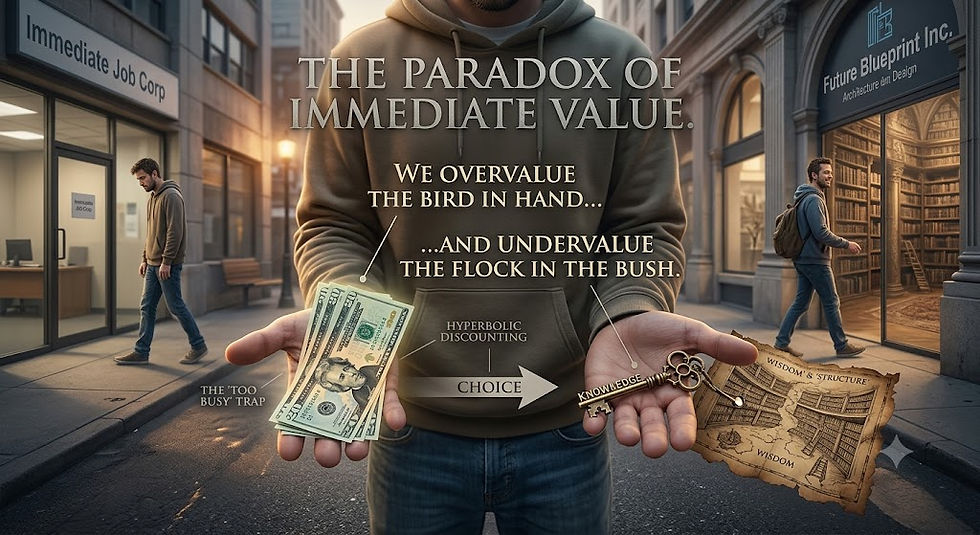
There is a profound systemic glitch built directly into the software of human psychology. As a species, we are hardwired to prioritize immediate, low-value rewards over deferred, monumental transformations. We will jump at a fistful of loose change while stepping completely over a map to a goldmine.
This is not a flaw of intelligence; it is a flaw of perspective—a massive blind spot in the rational mind that struggles to see any further than its own nose.
A stark, real-world baseline for this phenomenon occurred recently during a simple encounter in a coffee shop, offering a perfect diagnostic look into why human potential so often gets trapped in short-term thinking.
The Coffee Shop Experiment: A Tale of Two Value Systems
The setup was simple. While traveling, I struck up a brief conversation with an 18-year-old architecture student working as a waitress. Recognizing that her major aligned perfectly with a macro-capacity planetary development and framework project I have been architecting, I decided to test the waters of the younger generation's intuitive capacity.
I handed her the digital keys—two of my core websites dedicated to deep systemic frameworks of Knowledge and Wisdom—inviting her to peruse them and see if she wanted to learn.
When I returned a couple of weeks later, the psychological glitch exposed itself completely:
The Interaction:When asked if she had looked at the concepts, she replied nervously: "Yes, but I am too busy."Moments later, when asked inside if she accepted tips, she hesitated and said, "Anything you want." When pushed for a definitive answer—yes or no—she immediately replied: "Yes."

The data asymmetry here is staggering. She was "too busy" to invest a few minutes into reading concepts that could radically reframe her understanding of architecture, systems, and human advancement. Yet, the moment an immediate, low-tier monetary transaction was introduced (a tip), her schedule suddenly cleared, and her compliance was instant.
She walked right into a psychological trap: she optimized for pennies while completely missing an execution-level opportunity of lifetime value.
Anatomy of the Mental Blind Spot
Why does the human mind default to this backwards behavior? To understand how psychology goes wrong here, we have to look at three core cognitive failures:
1. The Proximity Trap (Hyperbolic Discounting)
Human beings are evolutionary pack animals designed to value a bird in the hand over a flock in the bush. In psychology, this is known as hyperbolic discounting. We overvalue immediate rewards (like cash tips) and drastically undervalue long-term, non-linear rewards (like wisdom or structural knowledge). Cash is concrete; a paradigm shift is abstract. Because the brain requires energy to process the abstract, it defaults to the concrete asset every single time, even when that asset is functionally worthless by comparison.
2. The "Too Busy" Defense Mechanism
When someone says they are "too busy" for something new, it is almost never a statement of chronological capacity; it is a statement of sorting priority. An 18-year-old student has the time; what she lacks is the framework to categorize a completely new, profound concept. When the mind is presented with something outside its narrow, daily loop of survival and routine, it experiences cognitive friction. "I'm busy" is simply the rationalization the ego uses to avoid stepping into the uncomfortable waters of higher learning.
3. The Illusion of the Monetary Metric
Society has conditioned the collective mind to believe that money is the ultimate arbiter of worth. We are trained to ask, "How much does it pay right now?" rather than "How much does it expand my capacity to execute?" Because she could not immediately tie a web domain about universal knowledge to her immediate utility bills, her brain flagged it as a lower priority than the tip jar.
The Higher Cost of Free Money
By answering "Yes" to the money and "No" (via avoidance) to the knowledge, she demonstrated a tragic inversion of real-world equity.
Money is a depreciating, transactional commodity. It is spent, gone, and leaves the container (the individual) completely unchanged.
Knowledge and Wisdom are structural multipliers. They alter the container permanently, allowing an architect, an engineer, or a creator to see structures, patterns, and opportunities that 99% of the population remains blind to.
This encounter is a masterclass in how humanity keeps itself small. The topic of deep systemic knowledge is something new for the world, and breaking through that crust of immediate gratification requires an active, conscious effort to override our basic programming. Until we learn to look past our noses and stop treating life like a series of quick transactions, we will continue to turn away the very keys meant to unlock our macro-capacity.
Leonardo Mora
CEO of Vision
GAWK Corporation



Comments