
The Expectation Trap: Why Unspoken Assumptions Ruin Conversations (and How to Fix Them)
- Leo Mora
- 2 hours ago
- 3 min read

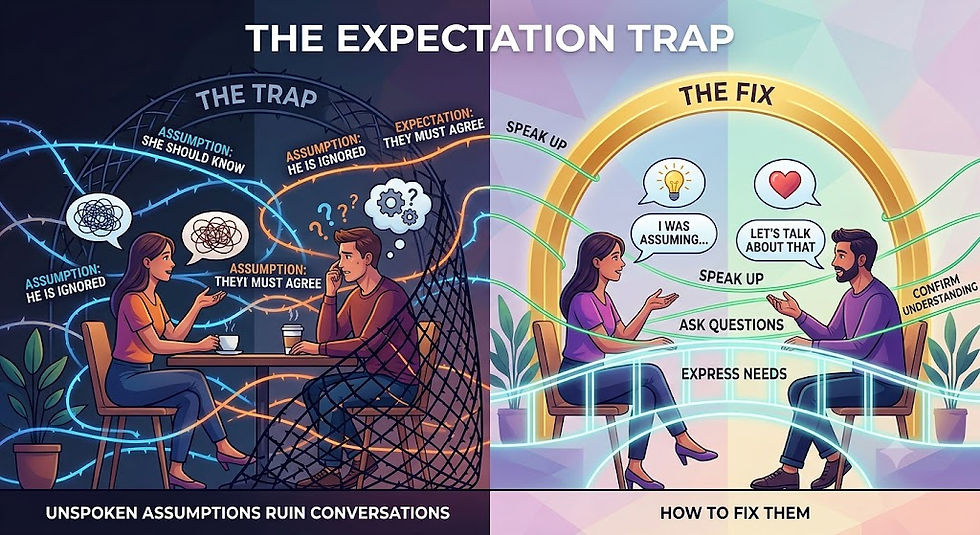
We’ve all been there: you enter a conversation with a clear idea of where it should go, how the other person should respond, or what questions they should ask. When they fail to hit those invisible marks, frustration sets in. The conversation stalls, solutions evaporate, and both parties walk away feeling misunderstood or defensive.
The root cause isn't a lack of intelligence or goodwill—it's expectation.
1. Why Expectations Kill Conversations and Solutions
When you carry fixed expectations into a dialogue, you stop listening to what is actually being said and start evaluating how far the other person is straying from your internal script.
It Creates Socratic Traps: Expecting someone to arrive at your preferred conclusion through conversation turns a collaborative dialogue into a test. When people feel tested, they shut down or get defensive.
It Blocks Creative Solutions: When you expect a specific answer, you close yourself off to unexpected perspectives. The best solutions often come from the space between different viewpoints, not from forcing someone into your pre-planned outcome.
It Replaces Empathy with Friction: When your primary focus is "Why aren't they seeing this?" you lose the ability to ask "How are they seeing this?"
2. The Myth of the "Right Question"
One of the most common conversational pitfalls is assuming that if the other person truly cared or understood, they would ask the right questions.
Here is the hard truth: they won't. Expecting people to ask the exact right questions assumes two things that are almost never true:
They have the exact same context, mental models, and background knowledge as you.
They know what information you are withholding until prompted.
People ask questions based on their mental framework, their immediate priorities, and their current level of understanding. Waiting for someone to stumble onto the "magic question" that unlocks your true thought or solution is an exercise in endless disappointment.
ExpectationRealityPractical Shift"If they care, they'll ask what went wrong."They don't know enough about the setup to know what to ask.Bridge the gap: Voluntarily supply the critical context."They should ask for my input on this solution."They assume you'll speak up if you have an idea.Offer directly: Frame your idea as an added perspective."They didn't ask the right follow-up, so they don't get it."They are processing through their own operational lens.Reframe: Translate your point into their priority terms.
3. The Practical Shift: Modify Your Response, Control the Encounter
If you cannot control what questions people ask or how they enter a discussion, the only variable you control is how you respond. To move from frustration to practical results, shift your approach from passive expectation to proactive guiding.
A. Don't Wait for the Prompt—Offer the Context
Instead of holding back information until asked, provide the high-value context upfront. Keep it concise so it doesn't sound like a lecture:
Instead of: "Ask me about the testing phase."
Try: "Before we decide on the deadline, there's a key detail in our testing phase we need to factor in..."
B. Translate Your Ideas into Their Language
People respond to what matters to them. If you are talking to a operational manager, frame your points in efficiency and workflow. If you are talking to a creative, frame them in vision and impact.
C. Guide with Direct Questions, Don't Test
If you need them to consider a specific angle, ask the question yourself rather than waiting for them to find it:
Instead of: Waiting for them to ask "What are the risks?"
Try: "What's the worst-case scenario if we launch this next week?"
D. Practice "Radical Clarity over Hinting"
Hinting and dropping subtle clues creates noise. If there is a problem or a solution you see, state it simply, calmly, and objectively.
Summary: The Practical Mindset
Communication isn't about finding people who speak your exact language; it's about becoming adaptable enough to build a bridge from wherever they are standing.
By dropping the expectation that others must read your mind or ask the "right" questions, you take complete ownership of your encounters. Conversations become tools for resolution rather than tests of patience.
Leonardo Mora
CEO of Vision
GAWK Corporation



Comments