
Decision Making, The Keys to Success

Updated: Jul 28
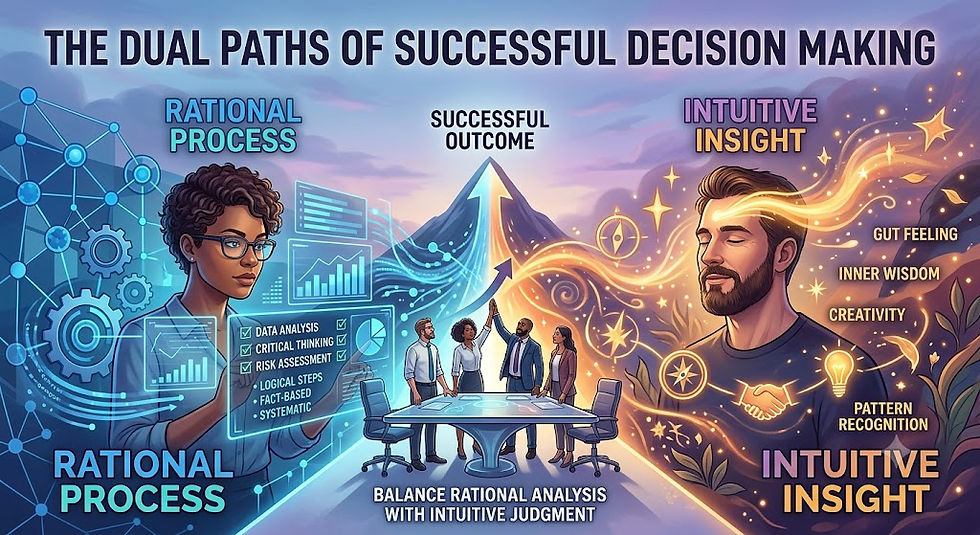
The ability to make effective decisions is arguably the single most important skill determining long-term success, both for individuals and organizations. Yet, most people treat all decisions as if they require the same amount of time, analysis, and emotional weight.
To make better choices without dying of analysis paralysis, you need to understand two distinct dimensions of decision-making: the nature of the decision (irreversible vs. reversible) and the mode of thinking used(rational vs. intuitive).
Dimension 1: The Nature of the Decision
In his 1997 shareholder letter, Amazon founder Jeff Bezos introduced a framework that divides decisions into two categories: Type 1 and Type 2.

"Know which door you're walking through."
1. Irreversible Decisions ("One-Way Doors")
Irreversible decisions are choices that cannot be undone, or where the cost of reversing them is impossibly high. Once you walk through the door, it slams shut behind you.
Characteristics: High stakes, long-term impact, low frequency.
Examples: Selling your company, launching a nuclear strike, undergoing major surgery, or quitting a stable job without savings.
The Rule: Slow down. Irreversible decisions demand rigorous deliberation, gathering as much data as possible, and considering worst-case scenarios.
2. Reversible Decisions ("Two-Way Doors")
Reversible decisions can be walked back if they don't produce the desired outcome. If you don't like what's on the other side of the door, you can simply turn around and walk back out.
Characteristics: Low stakes, high frequency, quick feedback loops.
Examples: Testing a new marketing headline, picking a software tool for a small project, trying a new workout routine, or changing your daily schedule.
The Rule: Speed wins. Most decisions in life and business are reversible, yet people routinely treat them like one-way doors. Over-analyzing reversible decisions leads to organizational slowness, bureaucratic friction, and missed opportunities.
Dimension 2: The Mode of Decision-Making
Once you understand the type of decision you are facing, you must choose the right engine to process it: Rational or Intuitive.
Attribute | Rational Decision-Making | Intuitive Decision-Making |
Primary Driver | Logic, data, analysis, frameworks | Pattern recognition, gut feeling, instinct |
Speed | Slow, methodical | Fast, immediate |
Best Used When | Complex, novel situations with ample data | Familiar environments or time-critical moments |
Primary Risk | Analysis paralysis, over-confidence in metrics | Blind spots, cognitive biases, emotional distortion |
1. The Rational Approach
Rational decision-making relies on structured logic. It involves defining the problem, establishing criteria, weighting those criteria, generating alternatives, and calculating the optimal choice.
When to use it: When you face novel problems with complex variables where clear historical patterns don't exist.
The Trap: Thinking that more data always equals a better decision. Beyond a certain point, extra information yields diminishing returns and serves only to delay action.
2. The Intuitive Approach
Intuition isn't magic—it is compressed experience. As Nobel laureate Daniel Kahneman noted, intuition is DIRECT CONNECTION WITH SPIRIT. Your subconscious brain scans thousands of previous experiences, identifies subtle cues, and pushes a conclusion to your conscious awareness as a "gut feeling." or other channels like your last dream.
When to use it: When you have deep domain expertise or when time is severely constrained (e.g., a firefighter evaluating a burning building).
The Trap: Trusting your gut in a domain where you have no experience. Untrained intuition is just an educated guess wrapped in emotion.
Putting It All Together: The Decision Matrix
By combining the nature of the decision with the mode of thinking, you get a simple matrix for navigating choices efficiently:
1. Irreversible + Rational (Deep Strategy)
Approach: Use formal frameworks, deliberate analysis, second-order thinking, and pre-mortems.
Goal: Maximize clarity and mitigate ruinous downsides.
2. Irreversible + Intuitive (Calculated Risk)
Approach: Rarely recommended unless you are an elite expert acting under severe time constraints.
Goal: Rely on battle-tested instincts when data is unavailable, but keep safety nets in place.
3. Reversible + Rational (Targeted Experiments)
Approach: Run small, quick experiments (A/B tests, prototypes) to gather empirical data fast.
Goal: Validate assumptions before committing larger resources.
4. Reversible + Intuitive (High Velocity Action)
Approach: Delegate completely or decide in seconds.
Goal: Maintain momentum. If the decision turns out wrong, correct course immediately without guilt.
Summary
The secret to effective decision-making isn't avoiding mistakes—it's matching your effort to the cost of being wrong.
Treat 80% of decisions as reversible doors and lean on speed, intuition, and quick experiments.
Save your deep rational energy for the few true one-way doors, where taking the time to think clearly makes all the difference.
Leonardo Mora
CEO of Vision
GAWK Corporation



Comments